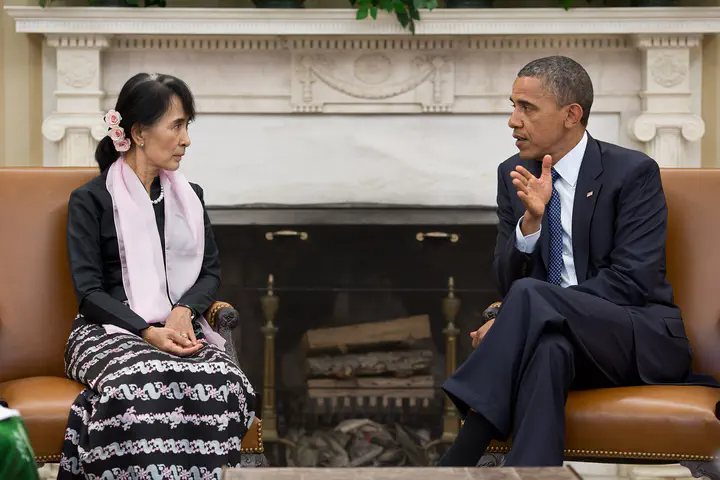
 President Obama meets with Aung San Suu Kyi of Burma, 2012. Image credit: Pete Souza.
Abstract
Under what conditions do states sponsor foreign nonviolent campaigns (FNCs) seeking to overthrow incumbent regimes? While political ideology plays a role, motivating liberal democracies to support (typically pro-democratic) campaigns, we argue strategic and material factors—specifically geo-political alignment and economic dependence—are central to explaining state sponsorship of FNCs, often overriding ideological and normative factors. A potential sponsor, whether democratic or autocratic, is unlikely to support FNCs when doing so jeopardizes a strategic partnership with the target regime, which may retaliate against the sponsor. Additionally, democracies are particularly deterred from supporting FNCs when the target regime can retaliate economically, such as by disrupting trade or other vital economic ties. To test these arguments, we leverage data from the External Support for Non-violent Campaigns Dataset, which documents global instances of state support for non-violent campaigns from 2000 to 2014. Consistent with our theory, we find that liberal democracies make up the vast majority of sponsors, but also that geo-political alignment between potential sponsor and target regime is strongly and negatively correlated with the provision of support. Moreover, economic dependence on the target reduces the likelihood of support among liberal democracies.

Christopher Wiley Shay, PhD
Research Associate
I study mass resistance movements, their legacies on societies and governments, and how these legacies help or hinder democratization.